














A simple childhood moment uncovered one of the biggest mysteries in human evolution.
In 2008, a 9-year-old boy in South Africa accidentally discovered a fossil that changed the history of human evolution forever. Learn the full story behind the “lost human ancestor” discovery and why scientists were stunned.
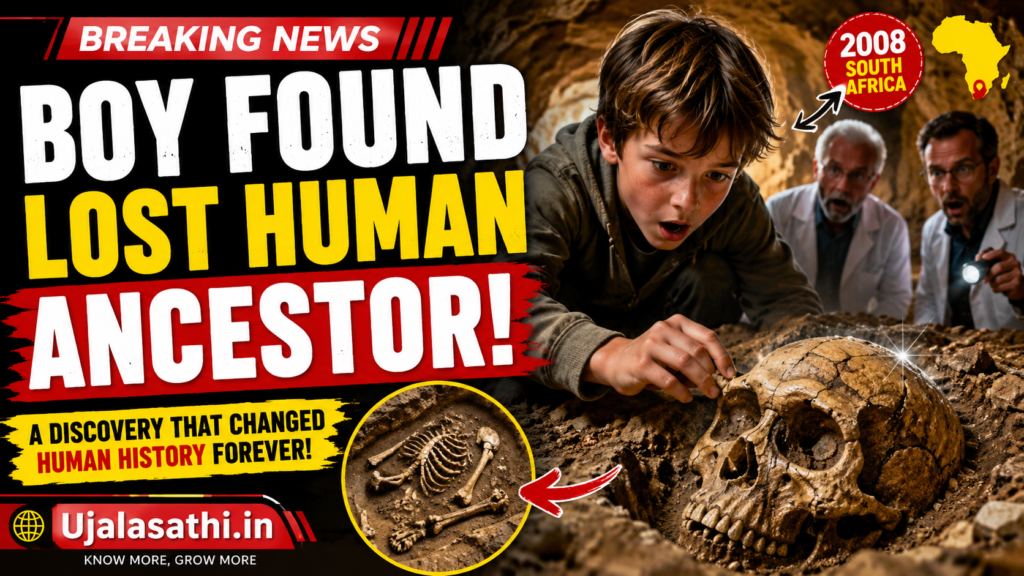
Introduction :
In 2008, a 9-year-old boy was chasing his dog when he tripped over a rock. What looked like an ordinary stone turned out to be a fossil belonging to one of humanity’s ancient ancestors.
This shocking discovery changed the scientific understanding of human evolution and became one of the most important paleoanthropology findings of the modern era.
Upcoming Topics :
- The Mysterious Discovery of 2008
- What Did the Boy Actually Find?
- Why Scientists Called It a “Lost Ancestor”
- What Is Australopithecus Sediba?
- Why This Discovery Matters in Human Evolution
- The Hidden Secrets of South African Caves
- What Researchers Learned from the Fossils
- Was It a Direct Human Ancestor?
- Why the World Was Shocked
- Important Details Table
- Common Questions and Scientific Challenges
- Expert Insights
- FAQ Section
- Conclusion
- Disclaimer
The Discovery That Changed Human History
Back in 2008, a young boy named Matthew Berger was exploring the Malapa area near Johannesburg, South Africa, while chasing his dog. During the walk, he accidentally tripped over a rock sticking out from the ground.
At first glance, it seemed like an ordinary stone. But after closer inspection, scientists realized it was actually a fossil bone belonging to an ancient human relative.
That single moment led to one of the most fascinating discoveries in the history of human evolution.
What Did the Boy Discover?
The fossil initially found by Matthew Berger included parts of a collarbone and jawbone from an ancient hominin species. After further excavation, scientists uncovered nearly complete skeletons buried deep within the cave system.
Researchers later identified the species as Australopithecus sediba, an extinct hominin believed to have lived around 1.98 million years ago.
The fossils were remarkably well-preserved, giving scientists rare insight into the transition between ape-like ancestors and modern humans.
Why Scientists Were So Shocked?
What made this discovery extraordinary was the unique combination of features found in the fossils.
The skeleton showed both primitive ape-like traits and advanced human-like characteristics, including:
- Human-like hands capable of gripping tools
- A pelvis similar to early humans
- Long ape-like arms for climbing
- A small brain but advanced body structure
Scientists described it as a “missing link” candidate because it appeared to bridge a major gap in human evolution.
What Is Australopithecus Sediba?
Australopithecus sediba is an extinct species of early hominin discovered in South Africa. The name “sediba” means “source” or “wellspring” in the Sesotho language.
Experts believe this species may represent an important evolutionary stage between earlier australopithecines and the genus Homo, which includes modern humans.
Some scientists even suggested that it could be closely related to the ancestors of Homo sapiens.
How Old Were the Fossils?
Using advanced dating techniques, researchers estimated the fossils to be approximately:
- 1.977 million years old
- Found in limestone cave deposits
- Preserved naturally after falling into a deep cave pit
The excellent preservation allowed scientists to study bones, teeth, posture, and movement in exceptional detail.
The Importance of the Discovery in Human Evolution
This fossil discovery became globally significant because it challenged many older theories about how humans evolved.
Before this find, scientists believed certain human features evolved separately over long periods. But Australopithecus sediba showed that several advanced traits may have developed much earlier than expected.
This changed discussions about:
- Human walking patterns
- Tool use abilities
- Brain evolution
- Hand structure development
- Social behavior of early humans
South Africa: The Cradle of Humankind
The fossils were discovered in the famous “Cradle of Humankind,” a UNESCO World Heritage Site in South Africa.
This region contains some of the world’s richest early human fossil sites and has produced numerous groundbreaking discoveries related to human ancestry.
The Malapa cave system became internationally famous after the 2008 discovery.
Did This Species Use Tools?
One of the most debated questions among scientists is whether Australopithecus sediba used tools.
Although no tools were directly found with the fossils, the hand structure strongly suggests advanced gripping ability. Researchers believe the species may have been capable of primitive tool-related activities.
This possibility has made the discovery even more important in understanding early human intelligence.
Why the Discovery Became Worldwide News
The story gained massive global attention because it sounded almost unbelievable:
- A child accidentally discovers a major fossil
- The fossils belong to a possible human ancestor
- The skeletons are incredibly well preserved
- The discovery could rewrite human evolution theories
Media outlets around the world described it as one of the most exciting anthropology discoveries of the 21st century.
Important Details Table
Detail Information
Discovery – Year2008
Discoverer – Matthew Berger
Location – Malapa, South Africa
Fossil Species – Australopithecus sediba
Estimated Age – About 1.98 million years
Scientific Importance – Possible transitional human ancestor
Research Field – Paleoanthropology
UNESCO Region – Cradle of Humankind
Common Problems & Scientific Challenges
1. Not All Scientists Agree
Some researchers believe Australopithecus sediba may not be a direct ancestor of humans.
Solution
Ongoing fossil studies and DNA-related research continue to improve understanding.
2. Limited Fossil Records
Human evolution still contains many missing gaps.
Solution
Scientists continue excavations in Africa and other regions to discover additional evidence.
3. Evolutionary Debate
Different experts interpret fossil evidence differently.
Solution
Modern scanning technologies and 3D analysis help researchers compare ancient species more accurately.
Expert Tips
Human evolution is not a straight line; it is a complex branching process.
Fossil discoveries can completely change scientific theories overnight.
Africa remains one of the most important regions for studying early humans.
Even accidental discoveries can become historic breakthroughs.
FAQ Section
1. Who discovered the fossil in 2008?
A 9-year-old boy named Matthew Berger discovered the fossil while exploring with his dog in South Africa.
2. What species was discovered?
Scientists identified the species as Australopithecus sediba.
3. How old were the fossils?
The fossils are estimated to be nearly 2 million years old.
4. Why is this discovery important?
It may help explain the transition between ape-like ancestors and early humans.
5. Where was the fossil found?
The fossils were discovered in the Malapa cave system in South Africa.
6. Was this species a direct human ancestor?
Scientists are still debating this question, but many believe it played an important evolutionary role.
7. Why did the discovery become famous worldwide?
Because it was accidentally found by a child and could reshape theories of human evolution.
Conclusion
The 2008 discovery of Australopithecus sediba remains one of the most fascinating stories in modern science. What began as a child chasing his dog turned into a groundbreaking moment in human history.
The discovery not only provided rare fossil evidence but also reminded the world that even the smallest accidents can lead to extraordinary scientific breakthroughs.
As researchers continue studying these ancient remains, humanity may come even closer to understanding its true origins.
Disclaimer
This article is based on publicly available scientific reports, media coverage, and fossil research studies. Scientific interpretations may evolve as new discoveries emerge.
Stay connected with Ujalasathi.in for more fascinating science discoveries, space mysteries, and breaking world news updates. Share this article with friends who love history and science.