














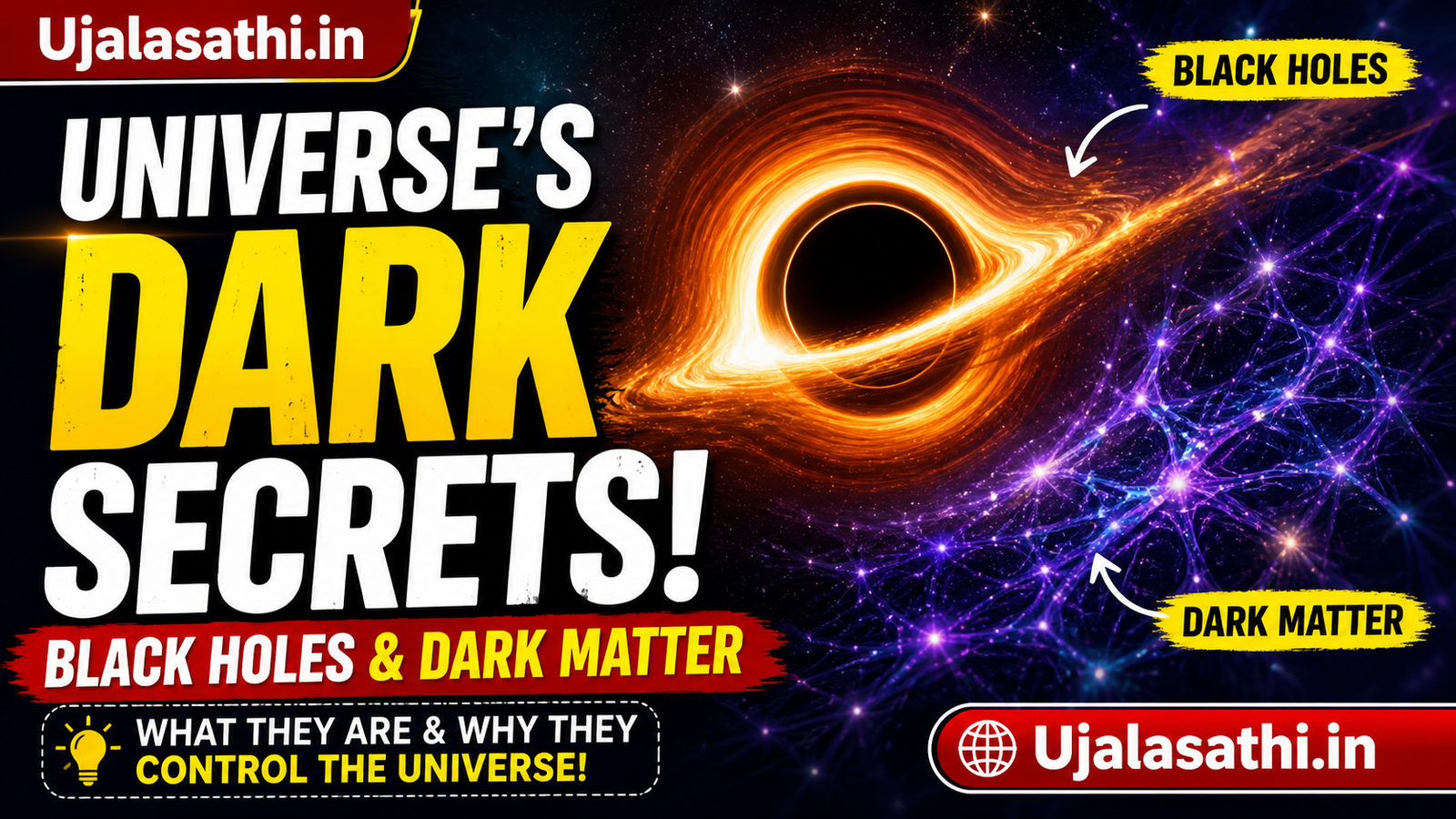
What is dark matter? Uncover the hidden forces shaping the universe… Black Holes and Dark Matter explained in the simplest way.
What are Black Holes and Dark Matter? Discover the latest 2026 insights, scientific facts, and mysteries of the universe explained in simple English.What is dark matter?Universe mystery.
Black Holes & Dark Matter are two of the most powerful and mysterious components of our universe, and scientists still don’t fully understand them.
They play a crucial role in shaping galaxies, controlling cosmic motion, and possibly determining the fate of the universe itself. If you’ve ever wondered what holds the universe together or what lies beyond visible space, this guide will answer your questions in the simplest way.
Upcoming Contents :
- What Are Black Holes?
- How Black Holes Form
- Types of Black Holes
- What is Dark Matter?
- Why Dark Matter is Important
- Black Holes vs Dark Matter
- Latest Discoveries (2026 Update)
- Role in the Universe
- Common Myths
- Future Research
What Are Black Holes & Dark Matter ?
A Black Hole is a region in space where gravity is so strong that nothing not even light can escape. This happens when a massive star collapses under its own gravity at the end of its life.
At the center of every Black Hole lies a point called a singularity, where density becomes infinite and the laws of physics break down.
How Black Holes Form?
Black Holes usually form when very large stars run out of fuel. Without energy to support them, they collapse inward due to gravity, creating an extremely dense object.
Some Black Holes also form when neutron stars collide or when massive gas clouds collapse in the early universe.
Types of Black Holes:
• Stellar Black Holes – Formed from dying stars
• Supermassive Black Holes – Found at the center of galaxies
• Intermediate Black Holes – Rare and less understood
• Primordial Black Holes – Hypothetical, formed during the Big Bang
What is Dark Matter?
Dark Matter is a mysterious substance that does not emit, absorb, or reflect light, making it invisible. Scientists cannot see it directly, but they know it exists because of its gravitational effects.
It makes up about 27% of the universe, while normal matter (stars, planets, humans) makes up only about 5%.
Why Dark Matter is Important?
Without Dark Matter, galaxies would not hold together. Stars would fly apart because visible matter alone is not enough to create the necessary gravitational force.
Dark Matter acts like an invisible glue holding galaxies intact.
Diffrence betwin Black Holes and Dark Matter
Feature – Black Holes – Dark Matter
Visibility- Invisible (detected indirectly)- Completely invisible
Gravity – Extremely strong – Weak but widespread
Location – Specific regions – Spread across universe
Composition – Collapsed Matter – unknown particles
Latest Discoveries (2026 Update)
Scientists are using advanced telescopes like the James Webb Space Telescope to study Black Holes and Dark Matter more closely.
Recent findings suggest :
• Supermassive Black Holes formed earlier than expected.
• Dark Matter may interact weakly with normal matter.
• New simulations show Dark Matter shaping galaxy formatio.
Role in the Universe:
Black Holes regulate star formation by consuming matter and releasing energy. Meanwhile, Dark Matter controls the large-scale structure of the universe.
Together, they influence how galaxies form, evolve, and move.
Common Myths :
Myth 1: Black Holes suck everything
Truth: Only objects that get too close are pulled in
Myth 2: Dark Matter is dangerous
Truth: It passes through us without any effect
Myth 3: Black Holes are cosmic vacuum cleaners
Truth: They behave like normal objects unless you’re nearby
Future Research
Scientists are trying to:
- Detect Dark Matter particles directly
- Understand what happens inside a Black Hole
- Combine quantum physics with gravity theories
- Future missions and experiments may finally reveal the true nature of these cosmic mysteries.
Important Details Table :
Topic Details
Universe Composition 5% normal matter, 27% dark matter, 68% dark energy
First Black Hole Image 2019
Telescope Used James Webb Space Telescope
Main Mystery Nature of dark matter
Scientific Status Still under research
Step by Step Process (How Scientists Study Them)
- Observe galaxy movements
- Measure gravitational effects
- Use space telescopes
- Run simulations
- Compare data with theories
Important Dates / Updates :
• 2019 – First Black Hole image captured
• 2021 – 2026 – James Webb discoveries
• Ongoing – Dark Matter detection experiments
Common Problems & Solutions
Problem: Cannot directly see Dark Matter
Solution: Study gravitational effects
Problem: Black Holes cannot be observed directly
Solution: Observe surrounding light and radiation
Expert Tips :
• Always rely on verified scientific sources
• Understand basics of gravity to grasp concepts
• Follow latest space missions for updates
FAQ
Q1. Are Black Holes dangerous to Earth?
No, there are no Black Holes close enough to affect Earth.
Q2. Can humans enter a Black Hole?
Theoretically yes, but survival is impossible.
Q3. Is Dark Matter proven?
Yes, indirectly through gravitational evidence.
Q4. Can we see Dark Matter?
No, it does not interact with light.
Q5. Do Black Holes destroy everything?
Only objects that cross the event horizon.
Q6. What is inside a Black Hole?
Unknown possibly a singularity.
Q7. Why is Dark Matter important?
It holds galaxies together.
Conclusion :-
Black Holes & Dark Matter are not just scientific topics they are the foundation of our universe’s structure. While Black Holes represent extreme gravity, Dark Matter acts as the invisible force holding everything together. Even in 2026, these remain among the biggest mysteries in science, and future discoveries could completely change our understanding of reality.
you can search on NASA Official Websites
- NASA main site: https://www.nasa.gov/
- NASA Science (missions, discoveries, articles): https://science.nasa.gov/
- NASA STEM & Learning Resources: https://www.nasa.gov/learning-resources/
Disclaimer :
This article is for educational and informational purposes only. Scientific research is ongoing, and new discoveries may update current understanding.
If you found this article helpful, share it with others, leave your thoughts in the comments, and keep visiting Ujalasathi.in for more such powerful insights!
Related Posts :