














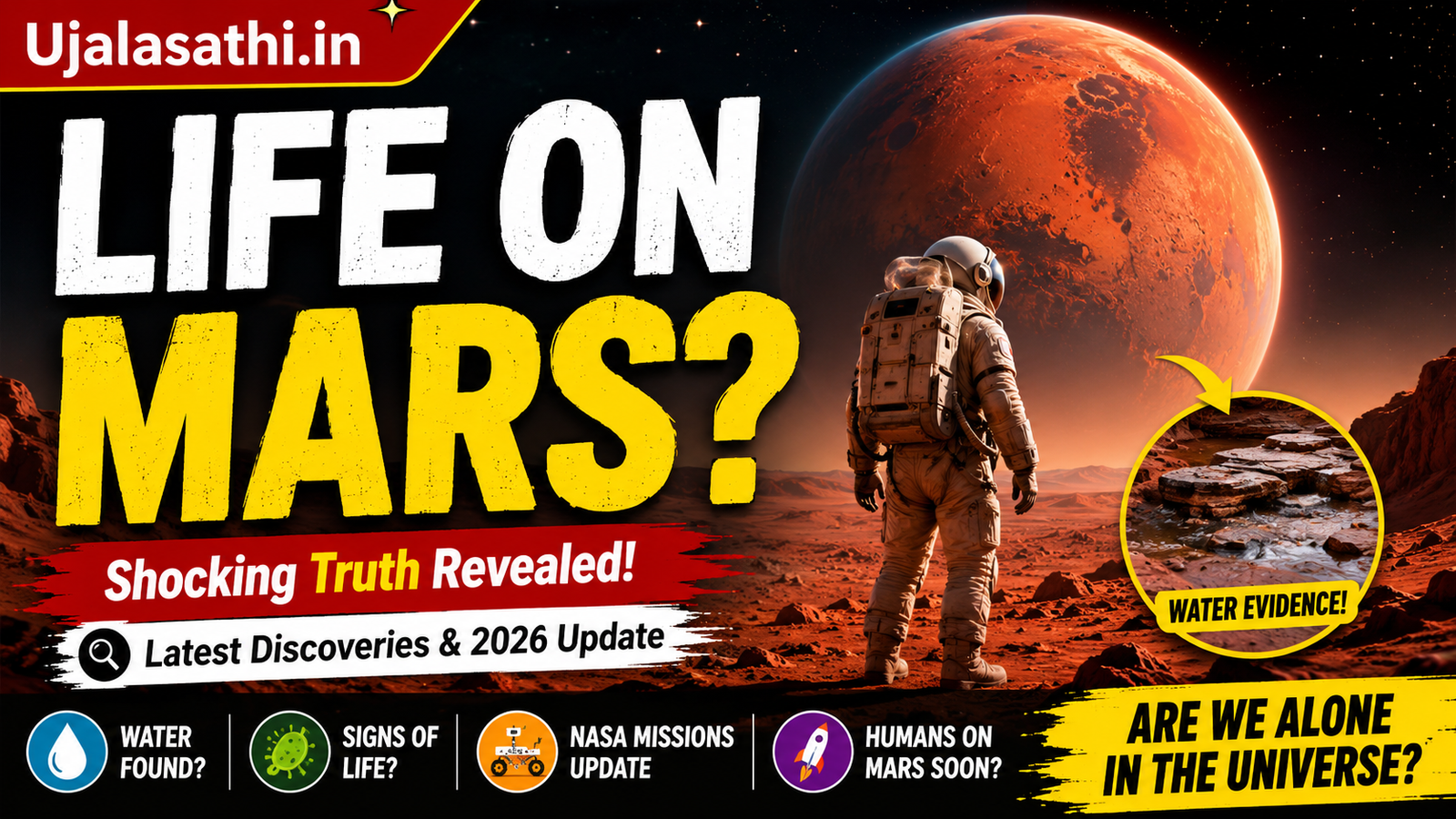
Life on Mars? The real science behind life on Mars . facts, discoveries, and future possibilities
Is there life on Mars or just a myth? Discover the latest 2026 findings, NASA missions, water evidence, and human colonization possibilities explained in simple English.
Life on Mars is not confirmed yet, but strong scientific evidence suggests that Mars may have once supported microbial life.
Scientists are actively searching for signs of life on Mars, and recent discoveries have made this possibility more exciting than ever.
The question of Life on Mars has fascinated humans for centuries. From science fiction movies to real space missions, Mars has always been seen as the most likely planet to host life beyond Earth. Today, with advanced technology and missions from NASA and other space agencies, we are closer than ever to finding the truth.
Table of Contents :
1) What is Life on Mars?
2) Why Mars is Important for Life Search
3) Latest Discoveries About Mars (2026 Update)
4) Evidence of Water on Mars
5) NASA Missions and Their Findings
6) Can Humans Live on Mars?
7) Challenges of Life on Mars
8) Future Missions and Plans
9) Important Details Table
10) Common Problems & Solutions
11) Expert Tips
12) FAQ
13) Conclusion
14) Disclaimer
What is Life on Mars?
Life on Mars refers to the possibility that living organisms especially microscopic life exist or once existed on the planet Mars. Scientists are mainly searching for microbial life, not advanced civilizations.
Mars is often called the “Red Planet” because of its reddish appearance, caused by iron oxide (rust) on its surface.
Why Mars is Important for Life Search?
Mars is one of the most Earth like planets in our solar system. It has:
• A similar day length (about 24.6 hours)
• Seasons like Earth
• Evidence of ancient rivers and lakes
These factors make Mars a strong candidate in the search for extraterrestrial life.
Latest Discoveries About Mars (2026 Update)
Recent missions have provided exciting updates about Life on Mars:
• Organic molecules have been detected in Martian soil
• Methane gas spikes observed, which may indicate biological activity
• Underground ice deposits discovered
• New data suggests Mars once had a thick atmosphere
These discoveries do not confirm life, but they strongly support the idea that life may have existed in the past.
Evidence of Water on Mars
Water is essential for life. Scientists have found strong evidence that Mars once had:
• Flowing rivers
• Large lakes
• Possibly even oceans
Today, water exists mostly as ice beneath the surface and at the poles.
NASA Missions and Their Findings
Several missions have focused on finding Life on Mars:
• Perseverance Rover (2021–Present): Collecting rock samples for future return to Earth
• Curiosity Rover: Found organic compounds and signs of ancient habitable environments
• Mars Reconnaissance Orbiter: Provides detailed images and climate data
These missions are helping scientists understand Mars like never before.
Can Humans Live on Mars?
The idea of humans living on Mars is no longer science fiction. Space agencies and private companies are working on it.
However, survival on Mars is extremely challenging because:
• No breathable oxygen
• Extremely cold temperatures
• High radiation levels
• No liquid water on the surface
Scientists are exploring solutions like building habitats, producing oxygen, and growing food.
Challenges of Life on Mars
Even if life existed, survival on Mars is difficult due to:
• Thin atmosphere
• Lack of magnetic field
• Frequent dust storms
• Limited resources
These challenges make it hard for life to exist or sustain itself.
Future Missions and Plans
The future of Life on Mars research looks promising:
• Sample return missions planned by NASA and ESA
• Human missions expected in the 2030s
• Advanced AI and robots will explore deeper regions
These missions may finally answer the question: Are we alone in the universe?
Important Details Table :
Topic Details
Planet Mars
Distance from Earth 225 million km
Atmosphere Mostly CO₂
Water Presence Ice and past liquid water evidence
Life Evidence Not confirmed, possible microbial past
Key Missions Perseverance, Curiosity
Step by Step Process (How Scientists Search for Life on Mars)
1) Send rovers and orbiters to Mars
2) Collect soil and rock samples
3) Analyze chemical composition
4) Search for organic molecules
5) Study atmosphere for gases like methane
6) Plan sample return missions
7) Test samples on Earth
Common Problems & Solutions
Problem: No direct proof of life
Solution: Advanced missions and better technology
Problem: Harsh environment
Solution: Underground exploration and protective habitats
Problem: Limited data
Solution: More missions and global collaboration
Expert Tips
• Focus on microbial life, not complex organisms
• Follow NASA and space agency updates regularly
• Understand that discoveries take time
• Look for scientific evidence, not myths
FAQ
1. Is there life on Mars right now?
– No confirmed evidence yet, but research is ongoing.
2. Did Mars ever have life?
– Possibly, especially microbial life in ancient times.
3. Why is Mars called the Red Planet?
– Due to iron oxide (rust) on its surface.
4. Can humans survive on Mars without a suit?
– No, the environment is too harsh.
5. Is there water on Mars?
– Yes, mostly in the form of ice.
6. Which mission is searching for life on Mars?
– NASA’s Perseverance Rover is one of the key missions.
7. When will humans go to Mars?
– Possibly in the 2030s.
Conclusion :
The question of Life on Mars remains one of the biggest mysteries in science. While we have not yet found direct evidence, the discoveries made so far strongly suggest that Mars once had conditions suitable for life. With upcoming missions and technological advancements, we may soon find the answer.
Disclaimer :
This article is based on current scientific research and publicly available data. Future discoveries may change our understanding of Mars and the possibility of life.
If you found this article helpful, share it with others, leave your thoughts in the comments, and keep visiting Ujalasathi.in for more exciting science updates.